
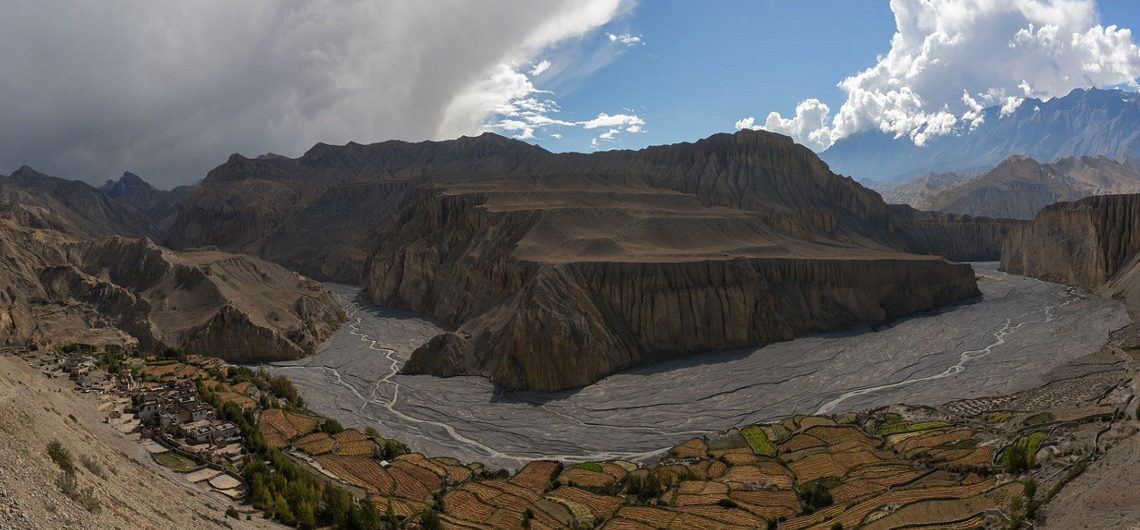
UPPER MUSTANG: NEPAL’S HIDDEN HIMALAYAN KINGDOM
The Mustang region of Nepal, located in the north-central Himalayas, is a place of breathtaking contrasts — arid desert landscapes, snow-capped peaks, ancient Tibetan culture, and sacred pilgrimage routes. Divided into Lower Mustang and Upper Mustang, this region offers both physical adventure and deep cultural immersion. The Upper Mustang area, in particular, was once an independent kingdom with strong ties to Tibet and remained closed to foreigners until 1992, preserving its unique heritage and traditions.
TREKKING IN MUSTANG AND UPPER MUSTANG
Mustang is one of Nepal’s most extraordinary trekking destinations. Unlike the green, forested trails of Everest and Annapurna, Mustang is located in the rain shadow of the Himalayas, offering dry, desert-like terrain, deeply eroded cliffs, and brightly colored rock formations.
Lower Mustang Treks
Lower Mustang, accessible by road and air, includes famous sites such as:
- Muktinath Temple– a sacred pilgrimage site for both Hindus and Buddhists.
- Jomsom– a windy town with modern amenities and an airport.
- Marpha– known for its whitewashed houses, apple orchards, and monastic culture.
- Kagbeni– the traditional gateway to Upper Mustang.
Treks here can be done in 5–7 days and are suitable for trekkers of all levels.
Upper Mustang Treks
The Upper Mustang trek is one of Nepal’s most culturally rich and visually striking adventures. The trek begins at Kagbeni and passes through villages like Chele, Geling, Tsarang, and finally Lo-Manthang, the ancient walled capital of the former Kingdom of Lo.
Trekkers experience:
- Tibetan Buddhist monasteries
- Caves with ancient murals
- High-altitude plateaus
- Desert-like valleys with stunning Himalayan backdrops
The Tiji Festival, held annually in Lo-Manthang, is a major draw for those interested in ritual dance and Tibetan Buddhist tradition.
CLIMBING AND EXPEDITIONS
While Mustang does not boast 8,000-meter peaks, it offers climbing and exploration opportunities in the Damodar Himal and Mustang Himal.
Popular Peaks for Climbing:
- Saribung Peak (6,328 m): A remote peak often climbed as part of the Saribung Pass trekconnecting Mustang with Nar Phu.
- Yakwakang Peak (6,482 m): Requires technical climbing skills.
- Bhrikuti and Khangla Peaks: Remote and less frequently climbed, offering solitude and alpine challenges.
These expeditions require logistical planning, experienced guides, and official climbing permits from the Department of Tourism.
CULTURE AND RELIGION
The Mustang region is a cultural extension of Tibet. The people of Upper Mustang follow Tibetan Buddhism, influenced by the Sakya and Nyingma sects, with strong elements of Bon, the pre-Buddhist faith.
Monasteries such as:
- Ghar Gompa
- Thubchen Monastery
- Lo Gekar Monastery(possibly the oldest Buddhist monastery in Nepal)
These are not only religious sites but also historical and artistic treasures. Prayer flags, mani walls, and chortens dominate the landscape.
In Lower Mustang, Muktinath Temple is sacred to both Hindus and Buddhists, where natural gas flames burn eternally beside icy springs. The temple symbolizes the fusion of spiritual traditions in this high-altitude region.
COMMUNITY AND ETHNIC GROUPS
Mustang is home to a mix of ethnic groups, each with its own language, customs, and social structure:
- Loba: The dominant group in Upper Mustang, culturally Tibetan. Their society historically practiced polyandryand followed primogeniture inheritance.
- Thakali: Found in Lower Mustang, especially Jomsom and Marpha. Known for business skills and distinctive cuisine.
- Tamang, Gurung, and Magar: Inhabiting areas along the southern approaches.
Most communities rely on agriculture, trade, yak herding, and increasingly, tourism. Villages are built from stone and mud, and festivals such as Lhosar (Tibetan New Year) and Tiji mark important religious and seasonal events.
BISTA: THE ROYAL FAMILY OF LO
Upper Mustang was once the Kingdom of Lo, a semi-independent principality with ties to Tibet. The Bista family ruled this kingdom for centuries. The last official king, Jigme Dorje Palbar Bista, was recognized by Nepal until the abolition of the monarchy in 2008.
Even today, the former royal palace in Lo-Manthang stands as a symbol of the region’s identity, and the Bista family is respected as cultural and spiritual leaders. Their legacy helps preserve Mustang’s traditions in an era of rapid modernization.
AIRPORTS AND ACCESS
- Jomsom Airportis the main gateway to Mustang. Daily flights operate from Pokhara, offering a scenic 20-minute journey along the Kali Gandaki Gorge.
- Road access has improved significantly, with jeep tracks now connecting Jomsom to Lo-Manthang, although weather and landslides can affect travel.
International visitors typically fly into Tribhuvan International Airport (Kathmandu) and then take a domestic flight or bus to Pokhara before heading to Mustang.
NATIONAL PARK AND CONSERVATION
Mustang is part of the Annapurna Conservation Area (ACA), Nepal’s largest protected area. It is managed by the Annapurna Conservation Area Project (ACAP), under the National Trust for Nature Conservation (NTNC).
The ACA covers over 7,600 sq. km and aims to:
- Conserve biodiversity (e.g., snow leopards, blue sheep)
- Promote sustainable tourism
- Protect cultural heritage
- Support local development through eco-tourism
Trekkers are encouraged to use environmentally responsible practices and respect local customs.
PERMITS REQUIRED
Traveling in Mustang, particularly Upper Mustang, requires several permits:
- Restricted Area Permit (RAP)– For Upper Mustang (north of Kagbeni):
- USD 500 per person for 10 days
- USD 50 for each additional day
- Must be obtained through a registered trekking agency with at least two trekkersand a licensed guide
- Annapurna Conservation Area Permit (ACAP):
- Required for all travelers in the region
- NPR 3,000 (approx. USD 25)
- TIMS Card (Trekkers’ Information Management System):
- Required for Lower Mustang
- NPR 2,000 for independent trekkers
Permits help support conservation and local communities, and trekkers must carry valid ID and copies of permits during travel.